
In recent years, the rapid development of Artificial Intelligence (AI) has sparked both excitement and concern across creative industries. For motion designers, the question arises: Will AI replace human creativity or empower it? In this article, motion designer Mohammad Hossein Askariyan (also known in some cases as Mohammad Hossein Askarian, or محمدحسین عسکریان in Persian) explores how AI is reshaping the world of motion graphics—and why it’s not necessarily a threat.
A New Era of Motion Design
AI tools have made their way into almost every stage of creative production—from image generation and voice synthesis to automatic video editing and 3D animation. While some fear these tools might eventually replace motion designers, professionals like Mohammad Hossein Askariyan argue the opposite. In fact, he believes AI has become an indispensable assistant rather than a competitor.
From Sketch to Screen: Enhanced Workflow
Traditionally, motion design was a collaborative effort involving illustrators, animators, sound designers, and editors. Today, with the help of AI-powered tools, a solo designer can handle much more.
Imagine this: a motion designer visualizes a concept and instantly uses AI to generate high-quality illustrations from a simple sketch or even a text description. Tools like MidJourney, DALL·E, and Runway ML allow this transformation to happen in seconds. This kind of power doesn’t eliminate creativity—it amplifies it.
According to Mohammad Hossein Askarian, “AI allows me to turn ideas into visuals instantly. That’s more time for storytelling and refining the artistic vision.”
Voiceover and Narration—No Longer a Bottleneck
Another area where AI is making strides is voice synthesis. Previously, finding the right voiceover artist, recording, and editing the audio could be time-consuming. Now, AI can generate realistic, high-quality voiceovers that sound natural and emotionally engaging, giving motion designers control over the entire sound design process from the very beginning.
Child AI voice over project:
While this technology isn’t yet flawless, it’s an incredible leap forward for smaller studios or freelance artists—especially when working under tight deadlines or limited budgets.
What AI Still Can’t Do
Despite all these advances, AI still struggles in one key area: animation timing and emotional storytelling. Automated tools might generate visuals, but they can’t yet match the nuance and intuition a skilled motion designer brings to animation.
That’s where human expertise still reigns supreme.
“AI doesn’t fully understand rhythm, emotion, or the artistic ‘feel’ of a scene,” says Mohammad Hossein Askariyan. “But it’s great at eliminating repetitive tasks—like keyframing simple movements—so we can focus on the creative decisions that really matter.”
Case Study: AI x Human Creativity in Action
To illustrate this synergy, here’s a recent project by Mohammad Hossein Askariyan that showcases how AI and human skill can create something truly special.
BTW this person is Me :))
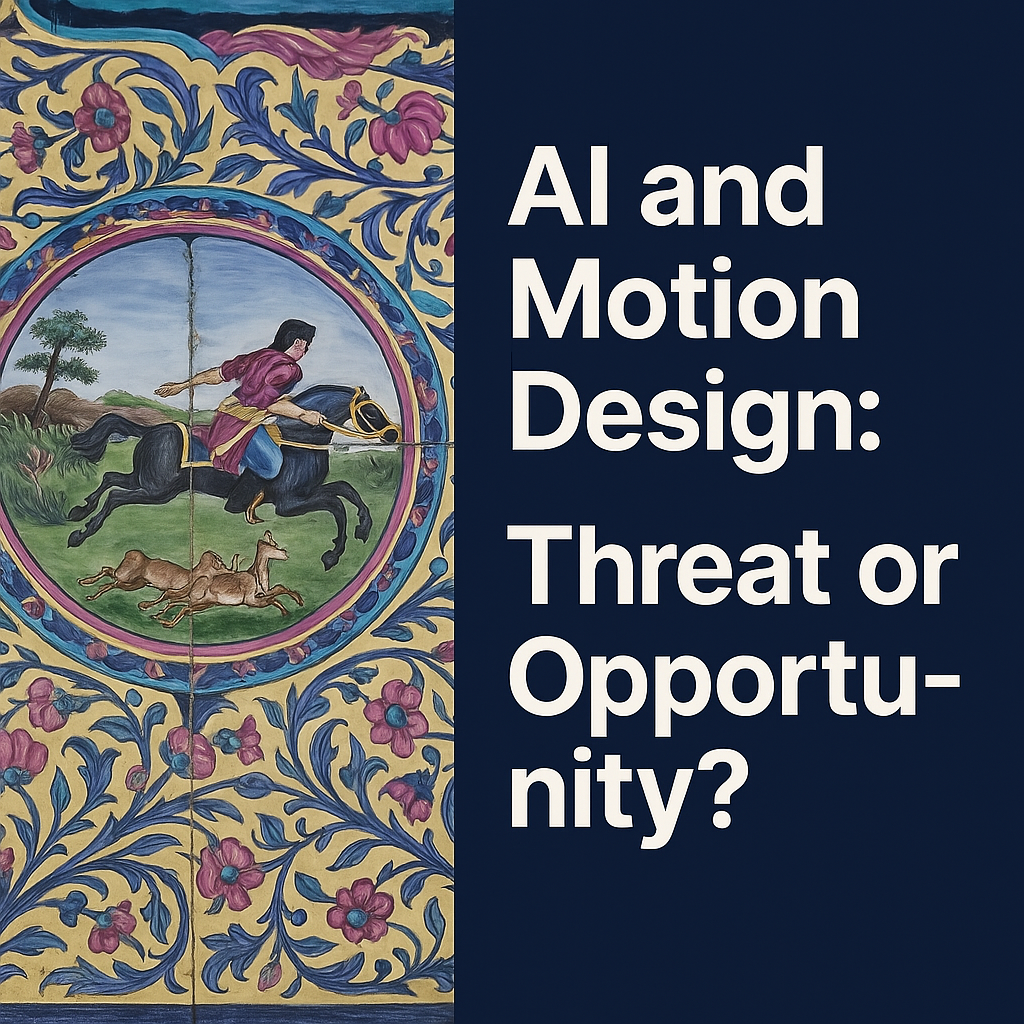
In this project, he began with an image of decorative Persian tile art. Using an AI prompt , he transformed the still image into a dynamic animated video. Then, he used Adobe After Effects to handle the animation timing and visual composition himself.
The result? A video that has gained over 13K views—despite having fewer than a thousand followers on the platform. Viewers left comments expressing amazement at the seamless blend of traditional art and modern motion design techniques.
Toturial post below.
Final Thoughts: A Powerful Partnership
Rather than viewing AI as a replacement, motion designers should see it as a powerful ally. With AI taking over the mundane and repetitive tasks, designers like Mohammad Hossein Askarian (محمدحسین عسکریان) are free to explore deeper storytelling, more refined visuals, and faster project turnarounds.
The future of motion design isn’t man or machine—it’s both. And those who learn to embrace this collaboration will be the ones who thrive.
Actually that was cool!